









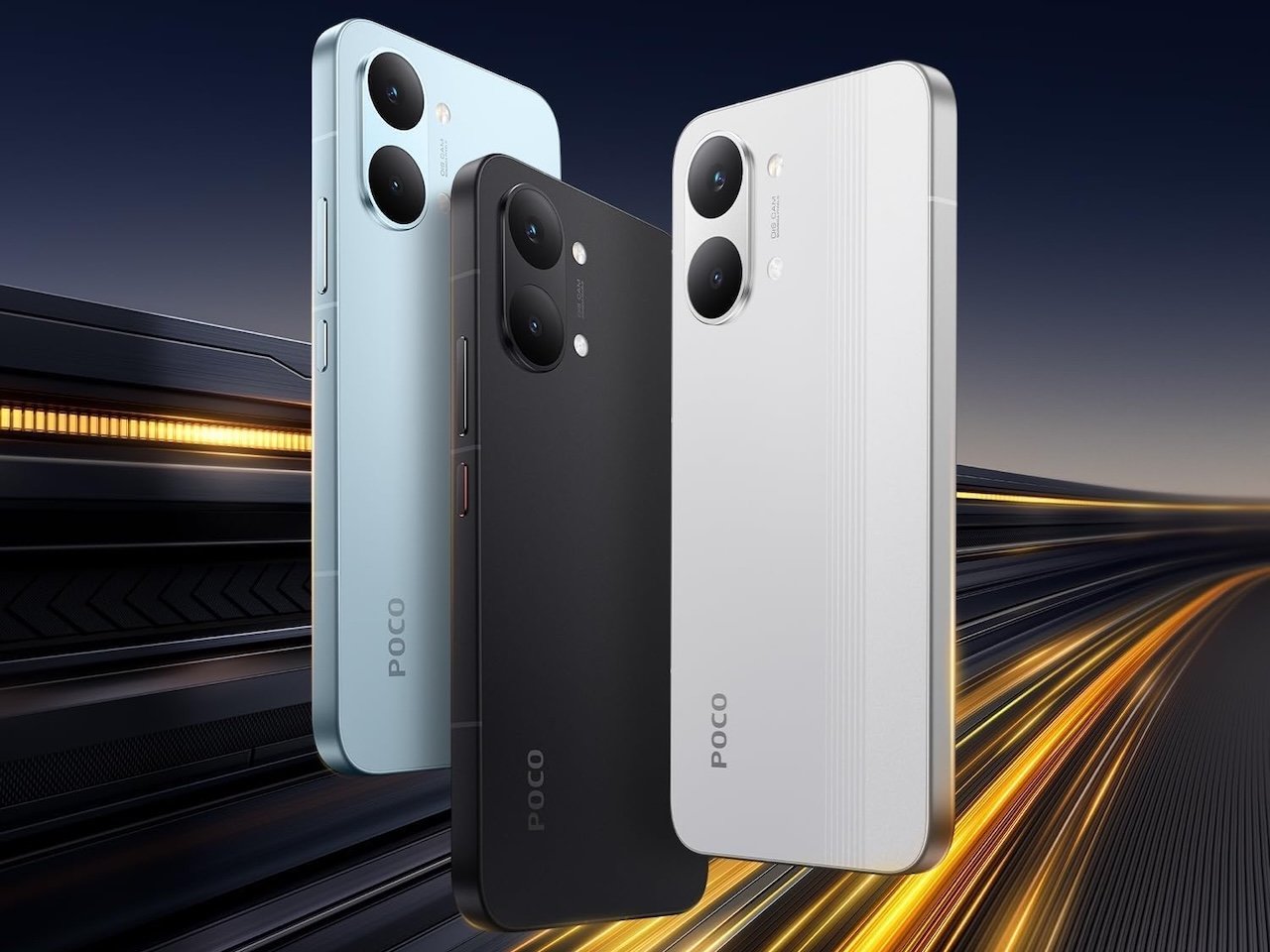
POCO X8 Pro Max review in one line: this is a large phone built around three things, a fast chip, a big AMOLED screen, and an 8500 mAh battery. It is made for heavy use, not for taking photos.
POCO X8 Pro Max review: quick summary
| What we liked | Large 120Hz AMOLED, Dimensity 9500s, 8500 mAh battery, 100W charging, ultrasonic fingerprint scanner |
| Main compromises | Size and 218 g weight, no wireless charging, simpler cameras than photography-focused phones |
| Who it’s for | Gamers, big-screen fans, and anyone who wants speed and long battery life |
| Who should skip it | Buyers who want a compact phone, or who care more about cameras and wireless charging than gaming power |
POCO X8 Pro Max specifications
| Parameter | Details |
|---|---|
| Display | AMOLED, 6.83″, 2772 × 1280, up to 120Hz |
| Peak brightness | Up to 3500 nits (25% of screen area) |
| Protective glass | Corning Gorilla Glass 7i |
| Processor | MediaTek Dimensity 9500s, 3nm, up to 3.73 GHz |
| Graphics | Immortalis-G925 MC11 |
| RAM | 12 GB LPDDR5X |
| Storage | 256 or 512 GB UFS 4.1 |
| Main camera | 50 MP Light Fusion 600, f/1.5, OIS |
| Ultra-wide camera | 8 MP, f/2.2 |
| Front camera | 20 MP |
| Battery | 8500 mAh, silicon-carbon |
| Charging | 100W wired, up to 27W reverse wired |
| Protection | IP68 |
| Connectivity | Wi-Fi 7, Bluetooth 6.0, NFC |
| SIM | 2 × nano-SIM or nano-SIM + eSIM |
| OS | HyperOS 3 (Android 16) |
| Size and weight | 162.9 × 77.9 × 8.2 mm, 218 g |
Box contents, feature availability, and network support vary by market. Official global specs list 12/256 GB and 12/512 GB versions, Wi-Fi 7, Bluetooth 6.0, eSIM, and IP68.
What’s in the box
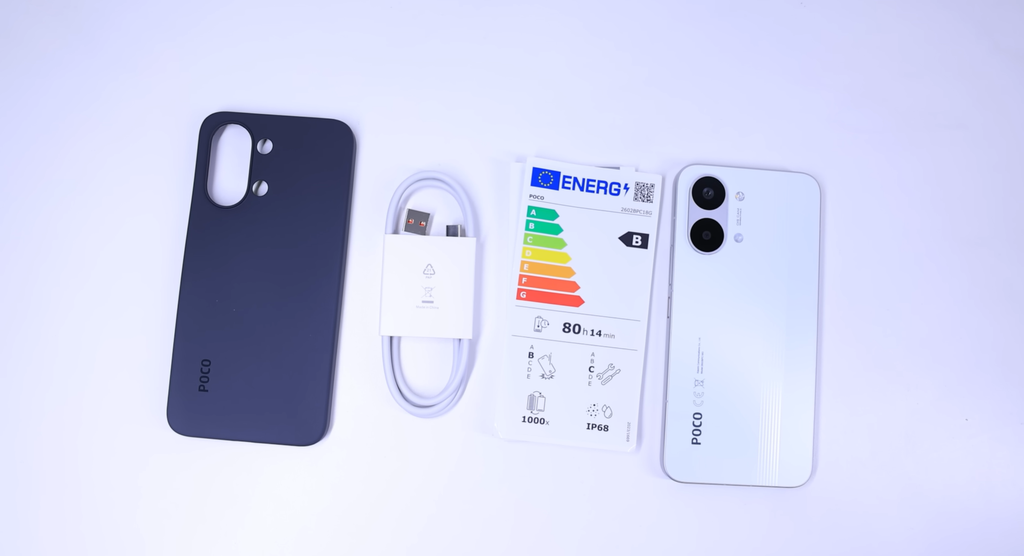
Contents depend on your region. Officially you get the phone, a USB Type-C cable, a SIM eject tool, a protective case, and documentation. The global POCO page says the power adapter may not be included.
That matters on a phone with 100W charging, because without a compatible adapter you won’t get the full HyperCharge speed. Check the box contents for your version before you buy.
Design and ergonomics
The phone measures 162.9 × 77.9 × 8.2 mm and weighs 218 g. With a 6.83-inch screen, nobody will call it compact. At 8.2 mm thick, though, it is slimmer than you would expect with an 8500 mAh battery inside.
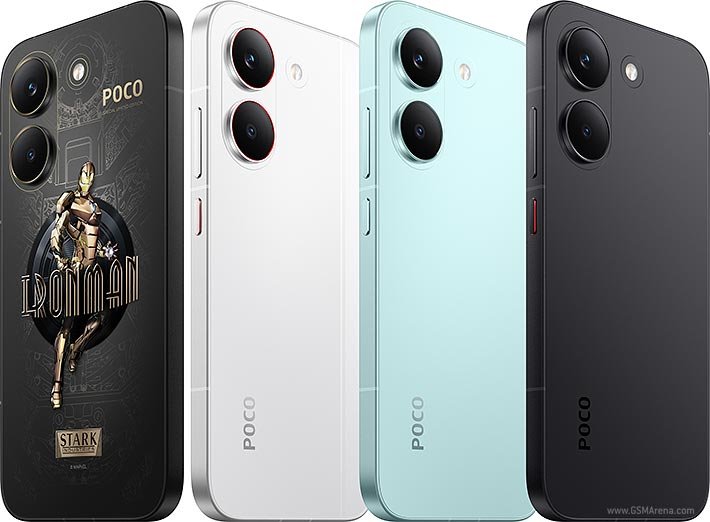
The frame is metal, the design is restrained, and the colors are black, white, and blue. A light ring around the camera block can flash for notifications, calls, charging, and some in-game events. The fingerprint scanner is ultrasonic and sits under the display, and POCO says it works with wet hands. The phone is rated IP68 for dust and water.
The slim body for the battery size is the best part of the design. The cost is that 218 g and almost 78 mm of width are easy to feel in your hand, so this phone suits people who already like big devices.
Display
The 6.83-inch AMOLED panel runs at 2772 × 1280 and up to 120Hz. It supports 12-bit color, the wide DCI-P3 gamut, HDR10+, and Dolby Vision.
Peak brightness is 3500 nits, but only on 25% of the screen. Full-screen high brightness mode reaches 2000 nits, and typical brightness is 800 nits. For eye comfort, the phone uses 3840Hz PWM dimming and carries TÜV Rheinland Low Blue Light, Flicker Free, and Circadian Friendly certifications. For gaming, touch sampling reaches 480Hz in Game Turbo, with instantaneous sampling up to 2560Hz.
The panel is not LTPO, so it can’t shift its refresh rate as smoothly as the screens on pricier phones. That is the only real knock against an otherwise excellent display.
Performance
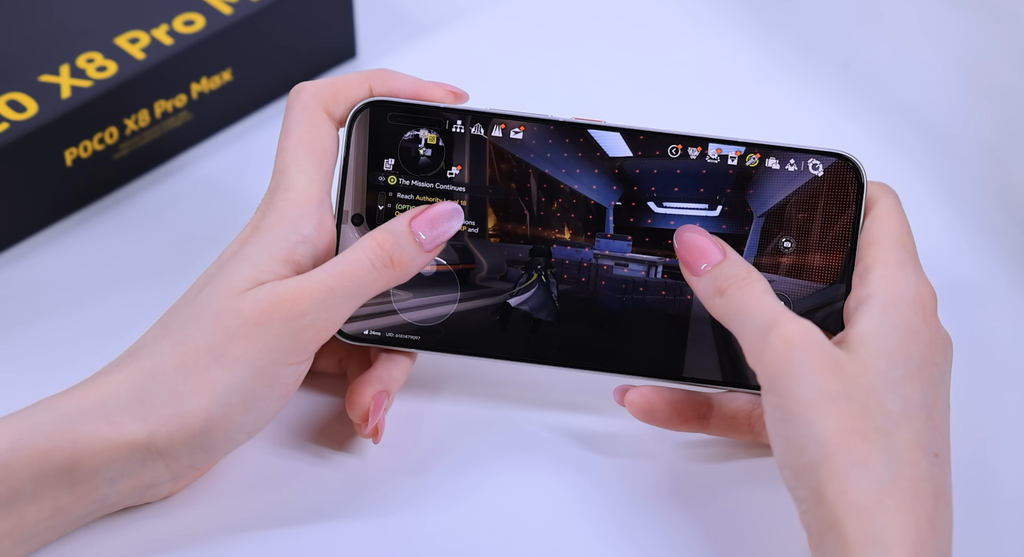
Performance is what separates this phone from a typical mid-ranger. It uses the MediaTek Dimensity 9500s, a 3nm chip with an all-big-core design and speeds up to 3.73 GHz. Graphics come from the Immortalis-G925 MC11, and memory is LPDDR5X (up to 9600 Mbps) paired with UFS 4.1 storage.
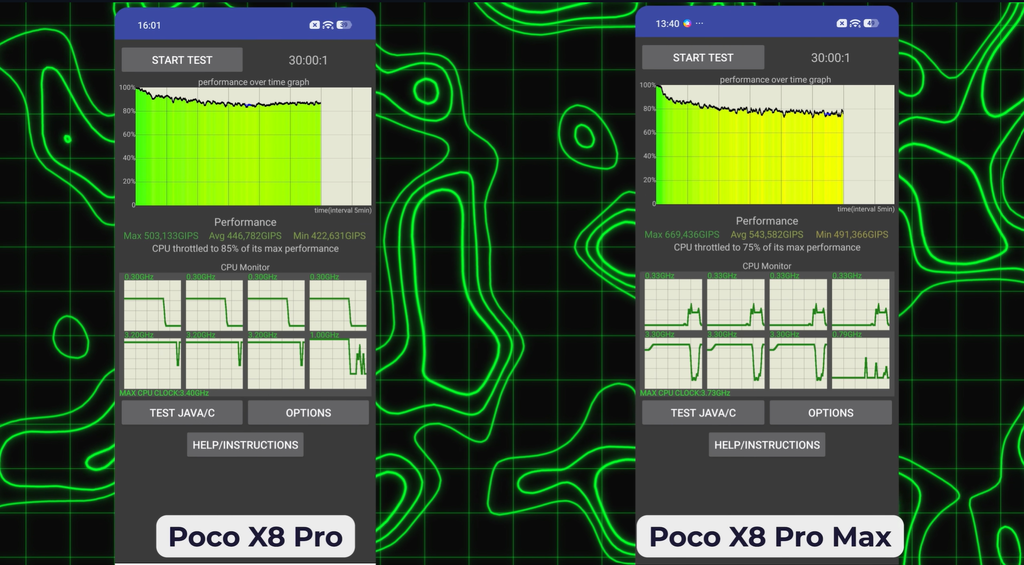
POCO reports an AnTuTu v11.0.5 score of 3,085,998. That is an internal result at about 25 °C, so don’t treat it as a guarantee for every unit. For cooling, the phone has the POCO 3D IceLoop system with a 5800 mm² heat pipe and an 11,000 mm² graphite layer. In POCO’s one-hour gaming test, the phone averaged about 60 FPS and peaked at 41.8 °C.
The chip has plenty of power for demanding games and heavy multitasking. How it holds up in long sessions will depend on the game, the room temperature, and the firmware.
Software and AI features
The phone ships with HyperOS 3 on Android 16, and features vary by region, language, and software version. POCO lists Google Gemini, Circle to Search, AI Writing, AI Speech Recognition, AI Interpreter, AI Search, and AI Dynamic Wallpapers. The gallery can remove objects and edit backgrounds, and the Hyper Island area shows live activities such as timers.
There are two caveats. Some AI tools don’t fully support every language (Ukrainian, for example). HyperOS also shows recommendations and promotional content in some system apps, though you can turn many of these off in app permissions and settings.
HyperOS 3 has a lot of features and runs fast on this chip. It is less minimal than some rivals.

Cameras
- Main: 50 MP Light Fusion 600, 1/1.95″ sensor, f/1.5, OIS
- Ultra-wide: 8 MP, no autofocus
- Front: 20 MP, video up to 1080p
- Video: 4K at up to 60 fps from the main camera
The main camera gives enough detail in good light for everyday shots. The 8 MP ultra-wide falls behind it, especially in tricky lighting, and there is no telephoto lens. Vloggers may want a phone with better front-camera video.
These cameras cover everyday photos and video. If photography matters more to you than speed, look at phones with stronger secondary cameras.
Battery and charging
The 8500 mAh silicon-carbon battery is the headline feature. POCO claims up to two days of use in a complex simulated scenario. Its lab figures are over 15 hours of gaming, over 16 hours of video calls, and over 74 hours of talk time. Your results will vary with brightness, network, refresh rate, and what you run.
- Wired charging: up to 100W, about 24 minutes from 1% to 50% with a compatible adapter in max-speed mode
- Reverse wired charging: up to 27W
- Wireless charging: not supported
The battery suits the chip and the gaming focus. Missing wireless charging is a small gap for most people, but it is the one premium feature this phone lacks.
Price and competitors
Pricing depends on the configuration (12/256 GB or 12/512 GB), so check the current price for your version on the POCO X8 Pro Max page on Androprice. For comparison, look at Samsung options such as the Galaxy A57.
Final verdict: is the POCO X8 Pro Max worth it?
This POCO X8 Pro Max review comes down to speed and battery life. The Dimensity 9500s, the large 120Hz AMOLED, the 8500 mAh battery with 100W charging, fast memory, and IP68 protection all point the same way. If you play demanding games or run your phone hard, it’s an easy phone to recommend.
If you want a small phone or great cameras, buy something else. This one is large and heavy, has no wireless charging, and has a simpler camera system than photography-focused models.
Pros
- Powerful MediaTek Dimensity 9500s
- 12 GB LPDDR5X RAM and up to 512 GB UFS 4.1 storage
- Large 6.83″ 120Hz AMOLED with Dolby Vision and HDR10+
- 1.5K resolution and up to 3500 nits peak brightness
- 3840Hz PWM dimming
- 8500 mAh battery with 100W wired charging
- 27W reverse wired charging
- Ultrasonic fingerprint scanner
- eSIM, Wi-Fi 7, and Bluetooth 6.0
- IP68 protection
Cons
- Large body and 218 g weight
- No LTPO display
- No wireless charging
- 8 MP ultra-wide camera
- No dedicated telephoto lens
- Some AI features depend on region and language
- Promotional recommendations may appear in HyperOS