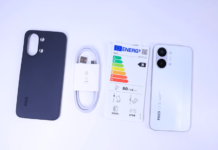










Xiaomi still sells a 4G Redmi Note, even though most of the world has moved on to 5G. We have both Redmi Note 17 5G battery test for both 5G and the 4G version, and we put each through our battery and charging tests. This post is about the 5G one. The 4G gets its own post next.
The two phones are nearly identical. The only difference is the chipset. The 5G model has the 4nm Snapdragon 4 Gen 4, and the 4G model has the 6nm Snapdragon 6s 4G Gen 2. Both were announced at the same time, but the 4 Gen 4 is on a newer node and has newer CPU cores, so it should be faster. Efficiency is the open question.

Redmi Note 17 5G battery test – Charging power
Both have a 7,700mAh Si/C battery, 45W charging and 22.5W reverse charging. Last generation was smaller and slower: 5,520mAh and 45W in the Note 15 5G (Snapdragon 4 Gen 3), 6,000mAh and 33W in the Note 15 4G (Helio G100 Ultra).
Starting with endurance, the Note 17 5G beats the Note 15 5G across the board. The Active Use Score is up by almost five and a half hours. It scales about the way you’d expect: 39% more capacity, 38% better score. That’s more impressive than it sounds, because the screen grew from a 6.77″ to a 6.99″ OLED (1080p+, 120Hz on both) and the phone still came out ahead. Efficiency went up slightly, just enough to offset the bigger panel.

Two other phones help put this in context. The Poco M8 Pro has a smaller 6,500mAh Si/C battery but charges at 100W. It has a Snapdragon 7s Gen 4 and a 6.83″ OLED at 1280p+.
The Redmi Note 17 Pro has 640mAh more battery than the Note 17 and still lasts less. We didn’t expect that. Its display is smaller (6.83″) and sharper (1280p+), and its 4nm Snapdragon 6s Gen 4 is nothing special. With that much extra capacity it should have won this one easily.
Redmi Note 17 5G battery test – Durations
Charging is where 45W shows its limits. It’s the minimum for a battery this size. The Note 17 5G was just under 25% after 15 minutes and at 41% after 30, which is enough for a full day, even for a heavy user.
The Poco M8 Pro makes the case for 100W: 83% in the same 30 minutes. Of course, two days of heavy use will be tough on the M8 Pro, and the Note 17 Pro manages it more easily. So you’re choosing between charging less often and waiting less when you do.
The Note 17 Pro doesn’t gain much here either. Its battery is 8% bigger (8,340mAh vs. 7,700mAh) and its charging is 49% faster (67W vs. 45W), yet it beat the regular Note 17 by only 5 minutes.
Redmi Note 17 5G battery test show that, the Outside the battery, this generation is a step back. The Note 17 5G and 4G lost the 108MP cameras of the Note 15 pair, and the chipsets are unimpressive, given that the Poco M8 Pro beats the Note 17. The battery is the one good upgrade, and it’s a good one. With an Active Use Score close to 20 hours, you can go 2-3 days between charges, depending on how much you use it.