








Xiaomi SU7 Max vs Xiaomi SU7 Ultra
Xiaomi SU7 Max vs Xiaomi SU7 Ultra, Both are five-metre electric sedans built by Xiaomi in Beijing. The SU7 Max is the dual-motor AWD flagship of the 2026 facelift, for people who want a fast daily car with long range. The Ultra is a tri-motor, 1,548 PS performance sedan for buyers who care about lap times. The comparison is timely because the refreshed SU7 went on sale in March 2026, and Europe is reportedly next, in 2027.
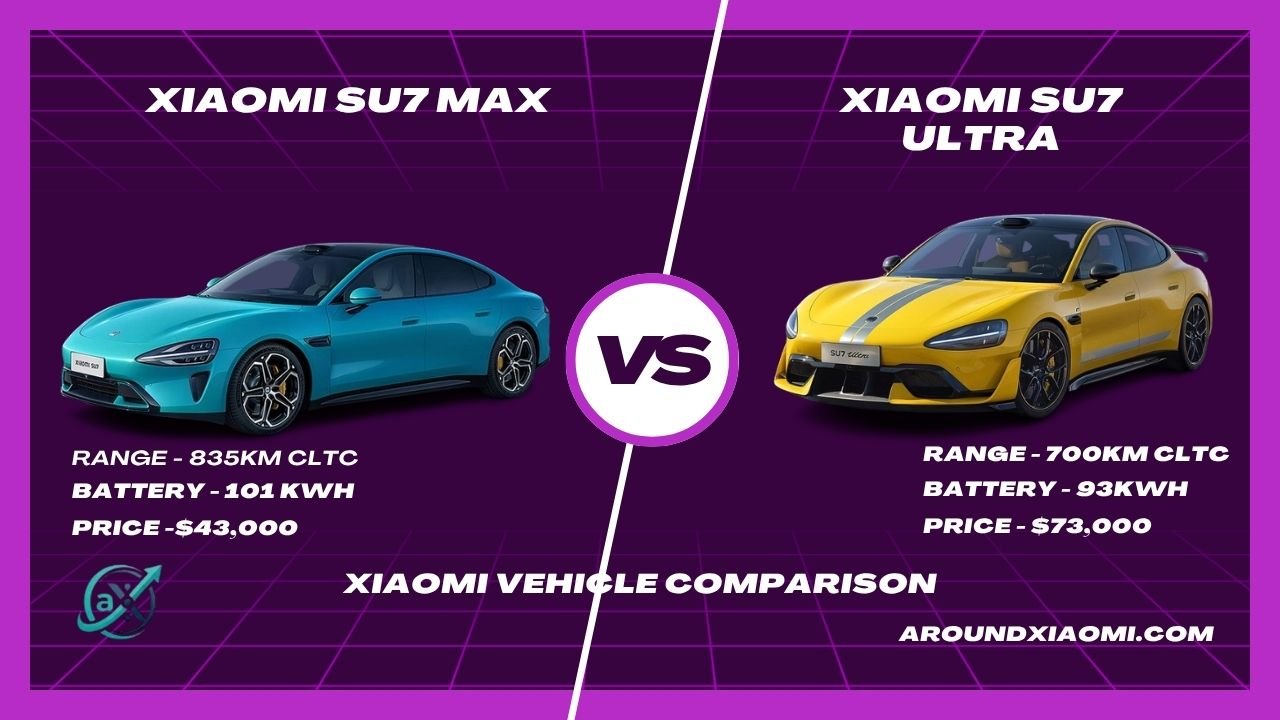
Xiaomi SU7 Max vs Xiaomi SU7 Ultra Range & Charging
Xiaomi SU7 Max vs Xiaomi SU7 Ultra, Both ranges are CLTC, China’s test cycle, which runs generous. The Max is rated at 835 km from a 101.7 kWh battery. The Ultra is rated at about 630 km from 93.7 kWh, though some sources say 620. My own real-world guess is about 600 km for the Max and about 500 km for the Ultra. Both take 11 kW on AC. On DC, the Ultra peaks near 480–490 kW, and the Max’s 897V system claims 670 km added in 15 minutes. Xiaomi claims 10–80% in roughly 11 minutes for both. One independent test of the Max logged about 18 minutes, so plan for that.
Price, Availability & Market Fit
The Max starts at RMB 303,900 (about US$44,000). The Ultra starts at RMB 529,900 (about US$73,000). The rest of the 2026 SU7 range is the Standard at RMB 219,900 and the Pro at RMB 249,900. Both cars are sold in mainland China only for now. Europe has been discussed for 2027, and there are no US plans. The real question for a buyer is whether the Ultra is worth about RMB 226,000 more than the Max.
Ecosystem & Rivals
Xiaomi also sells the SU7 Pro, which has the longest range of the family at 902 km CLTC, and the YU7 SUV. The YU7 GT is its performance SUV. Outside the brand, the Zeekr 7X is a fair cross-shop for Max money, and the Porsche Taycan Turbo for Ultra money. This pairing still works best because both cars share a platform and software, so the price gap shows exactly what the extra money buys.
Quick Verdict
Choose the SU7 Max if you want long range, strong everyday performance and the lower price. Choose the SU7 Ultra if acceleration and peak charging speed matter more than range and cost. The Max covers what most drivers need. The Ultra is a large premium for performance that mainly shows up on a track or a empty road.

| |
| Price | $43,000.00 $73,000.00 |
| Our Rating | |
| Brand | Xiaomi Xiaomi |
| Category | Xiaomi Cars Xiaomi Cars |
MODEL
| Full Model Name A full model name is the complete, specific designation of a product, software, or system that includes its brand, series, version, and technical configuration. | Xiaomi SU7 Max Xiaomi SU7 Ultra |
| Segment / Class Segment and Class refer to ways of dividing a large group, data set, or concept into smaller, organized parts. | E-segment executive sedan Full-size electric performance sedan |
| Powertrain Options Powertrain options refer to the different choices available for a vehicle's power-generating and power-delivering system—the complete assembly that creates energy and pushes the car forward. | AWD AWD |
PRICE & AVAILABILITY
| Base Price A base price is the starting cost of a product or service before adding any extra fees, taxes, optional upgrades, or discounts | 690 hp Max trim comes with a 101.7 kWh battery pack and 835 km CLTC range, priced around 303,900 yuan (~$43,000 USD) RMB 529,900 (~$73,000 USD) |
| Availability Status Availability status means the current condition or state of whether a person, product, system, or resource is accessible, online, or ready for use. | On Sale On Sale |
| Markets Available "Markets available" generally means the specific geographic regions, stores, or consumer groups where a product or service is ready and offered for sale. | China only China only (global expansion targeted 2027+) |
| Brand / Manufacturer brand is the name, term, design, or symbol that identifies a seller's product and shapes public perception, while a manufacturer is the actual company that physically produces or builds the goods. | Xiaomi Auto Xiaomi Auto (Xiaomi EV) |
BATTERY & CHARGING
| Battery Capacity Battery capacity is the total amount of electrical energy a battery can store and deliver, functioning much like the size of a fuel tank. | 101.7 kWh gross / ~99 kWh usable (NMC/ternary lithium) 93.7 kWh usable / 95.0 kWh gross (CATL Qilin II, NMC) |
| Range The word range means a set of different things, a scale between limits, or the distance an object can cover. | 835 km CLTC (~660–680 km est. WLTP) 620–700 km CLTC |
| DC Charging DC charging stands for direct current charging, a high-power method that sends electricity straight to an electric vehicle's battery without needing an internal conversion step. | Up to 529 kW peak; 5.2C ultra-fast charging Up to 480 kW peak |
| Charging Time Charging time is the total length of time required to recharge a battery from empty to full capacity. | 10–80% in ~12–18 min; 0–100% in ~39 min 10–80% in ~11 min |
| AC Charging AC charging means supplying alternating current (AC) from the electrical grid to an electric vehicle, where the car's built-in onboard charger converts it into direct current (DC) to power the battery. | Up to 11 kW onboard charger 11 kW (0–100% in ~8.5 hrs) |
| Battery Warranty A battery warranty is a guarantee from a manufacturer or seller to repair or replace a battery if it fails due to factory defects within a set time. | Not publicly specified 8 years / 160,000 km |
| Energy Consumption Energy consumption is the total amount of energy used by a person, building, device, or country over a specific period. | 11.9 kWh/100 km (CLTC) ~13.4 kWh/100km CLTC |
PERFORMANCE
| Power Output Power output is the rate at which a device, system, or living body generates, transfers, or delivers energy (doing work over time). It is typically measured in watts (W) or kilowatts (kW). | 508 kW (691 hp) 1,138 kW / 1,548 hp combined |
| Acceleration Acceleration is the rate at which an object changes its velocity over time. | 0–100 km/h in 3.08 sec 0–100 km/h in 1.98s |
| Motor Configuration Motor configuration refers to the physical layout, internal electrical wiring setup, or software/hardware settings of a motor. | Dual motor — front induction motor + rear PMSM, AWD Tri-motor (2× rear HyperEngine V8s + 1× front V6s) |
| Torque the rotational equivalent of linear force—it is the twisting or turning power that causes an object to rotate around an axis or pivot point. | 866 Nm 1,770 Nm |
| Top Speed Top speed means the highest or maximum velocity that a vehicle, runner, or object can achieve under ideal conditions. | 265 km/h 350 km/h |
BODY & DIMENSIONS
| Dimensions A dimension is a measurement in a specific direction (such as length, width, or height) or a distinct aspect, feature, or scope of a situation. | 4,997 mm (L) × 1,963 mm (W) × 1,440 mm (H) 5,070 / 1,970 / 1,465 mm (wheelbase 3,000mm) |
| Trunk/Boot Capacity Trunk or boot capacity refers to the total volume of storage space available in the rear cargo compartment of a vehicle. | 493 L ~493–517 L |
| Body Style A car's body style refers to the overall shape, structural design, and external configuration of a vehicle. | 4-door sedan 4-door sedan |
| Kerb Weight Kerb weight is the total mass of a vehicle with all standard equipment and necessary operating fluids, but without any passengers or cargo. | 2,205 kg 2,360 kg |
| Ground Clearance Ground clearance is the vertical distance between the lowest part of a vehicle's frame or undercarriage and the flat ground below it | 140–160 mm (adaptive air suspension) Not publicly specified |
| Frunk/Bonnet Capacity Frunk/bonnet capacity is the total volume of storage space available under the front hood (bonnet) of a vehicle. | 105 L 105 L |
| Sunroof A sunroof is a movable panel in a vehicle's roof that opens or tilts to let in fresh air and sunlight. | Full-length panoramic glass roof (fixed, not opening) Yes, panoramic glass roof |
SAFETY & DRIVER ASSISTANCE
| ADAS Features ADAS stands for Advanced Driver Assistance Systems, which are electronic technologies in modern vehicles designed to increase road safety, enhance driving comfort, and prevent crashes by minimizing human error. | LiDAR + 4D mmWave radar + 8 cameras + 12 ultrasonic sensors; AEB, lane keep/centering, blind-spot monitoring, cross-traffic alerts, automatic parking Xiaomi HAD (adaptive cruise, lane keep, AEB, blind spot, forward collision warning) |
| Autonomous Driving Level Autonomous driving levels are a standardized six-stage classification system created by SAE International (ranging from Level 0 to Level 5) that measures how much control a vehicle's automated system takes compared to a human driver | SAE Level 2 (Xiaomi Pilot Max / "HAD") L2+ (driver assistance, not full autonomy) |
| Crash Test Ratings Crash test ratings are standardized scores that measure how well a vehicle protects its occupants during controlled collision simulations. | No official Euro NCAP/C-NCAP rating Not yet published (no C-NCAP/Euro NCAP rating) |
| Over-the-Air (OTA) Updates An Over-the-Air (OTA) update is the wireless delivery and installation of software, firmware, or operating system updates to a connected device via Wi-Fi or cellular networks | Yes, supported via HyperOS Yes |
COMFORT & SEATING
| Seating Capacity Seating capacity means the maximum number of people who can sit in a specific space, vehicle, or venue. | 5 5 |
| Seat Material Seat material refers to the fabric, leather, or synthetic substance used to cover or build a seating surface. | Nappa leather (black, red, gray, purple options) Leather/synthetic |
| Wireless Charging Wireless charging is a cable-free method that powers electronic devices by transferring energy through electromagnetic fields instead of a physical plug. |
DISPLAYS & CONNECTIVITY
| Centre Screen A centre screen (or center display) is a built-in digital display panel located in the middle of a vehicle's dashboard or console | 16.1-inch touchscreen 16.1" 3K touchscreen (Xiaomi HyperOS) |
| Mirror Link MirrorLink is a connectivity standard that projects a smartphone’s screen and compatible apps onto a car's built-in infotainment dashboard. | |
| Apple CarPlay Apple CarPlay is a smart software standard created by Apple that puts an iPhone interface directly onto a car's built-in display screen. | |
| Android Auto Android Auto is a software platform developed by Google that projects a driver-safe, simplified version of your Android phone onto your car's central dashboard display | |
| Driver's Display A driver's display is the digital or analog instrument panel mounted directly behind the steering wheel that shows real-time driving data like speed, fuel or battery level, and warning alerts | 7.1-inch instrument cluster 7.1" digital cluster |
| Head-Up Display (HUD) A head-up display (HUD) is a transparent screen that projects data directly into your line of sight so you never have to look away from your main view. | Standard Yes, standard (AR HUD) |
KEY EV TECH
| Vehicle-to-Load (V2L) Vehicle-to-Load (V2L) is a bidirectional charging feature in some electric vehicles (EVs) that turns the car's high-voltage battery into a mobile power source for external electrical devices. | |
| Vehicle-to-Grid (V2G) Vehicle-to-Grid (V2G) is a system that allows electric vehicles (EVs) to send stored electricity back into the public power grid using bidirectional (two-way) chargers. |
ADDITIONAL SPECS
| Headlight Type Headlight "types" refer to either the lighting technology used (like halogen or LED) or the socket/bulb code (like H7 or HB3) required for your vehicle's specific assembly | LED Matrix LED (split/matrix design) |
| Adaptive Headlights Adaptive headlights are intelligent vehicle lighting systems that automatically change their direction, range, or brightness to match driving conditions and improve nighttime visibility. | |
| Sound System Brand Audio branding (also called sonic or sound branding) is the strategic use of music, voice, and unique sounds to give a brand an audible identity | Xiaomi Sound System — 25 speakers, 1,526W 25-speaker Dolby Atmos setup |
| Speaker Count Speaker count is the audio processing task of automatically estimating the total number of unique or simultaneous people speaking in a recording. | 25 25 |
| Navigation System A navigation system is an electronic tool that finds a vehicle's exact location and guides the user along a route to a destination. | Built-in, real-time traffic Yes (built into HyperOS) |
| Face Recognition Face recognition is a technology that uses computers to identify or verify a person's identity by analyzing unique facial features from a digital image or video. | |
| Fingerprint Sensor A fingerprint sensor is an electronic biometric hardware device that captures the unique pattern of ridges and valleys on a fingertip to identify and authenticate a person. | |
| Remote Parking Remote parking means an advanced driver-assistance technology that lets you park or move your vehicle using a smartphone app or a key fob while standing outside the car. | |
| Official Dealer Network An Official Dealer Network is a group of authorized, independent businesses approved by a manufacturer to sell, maintain, and repair its products in specific regions. | Xiaomi Auto stores/service centers, China only China only, Xiaomi-owned retail stores |
| Service Interval A service interval is the recommended schedule of distance, time, or operating hours between routine maintenance checks for a vehicle or piece of equipment. | Not publicly specified Not publicly specified |
| Roadside Assistance Roadside assistance is a support service for drivers whose vehicles break down or stop working due to a mechanical failure, flat tire, or dead battery | Not publicly specified Included in China |
NOTE
| Data Source A data source is the origination point or specific location where information comes from before it is collected, processed, or analyzed | EVKX.net, CarNewsChina, Jinyu Autos, Auto-Data.net (2026 model year) CarNewsChina, EVKX.net, Wikipedia, ArenaEV, Xiaomi official (as of Sept 2026) |


|
New Arrivals












Popular Posts