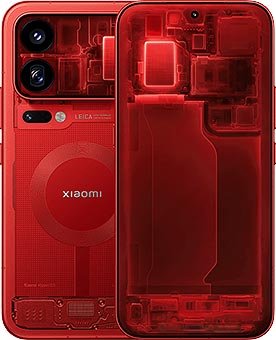











Poco F9 Ultra vs Xiaomi 18 Fold
Poco F9 Ultra vs Xiaomi 18 Fold, Both phones come from Xiaomi, but they’re built for different people. The Poco F9 Ultra is a regular slab flagship from Xiaomi’s performance sub-brand, aimed at gamers and heavy video watchers who want top hardware without Samsung prices. The Xiaomi 18 Fold is a passport-style foldable for anyone who wants a phone and a small tablet in one device. Poco showed the Ultra on September 1, and Xiaomi launched the Fold in China on September 7, so you can look at both right now.
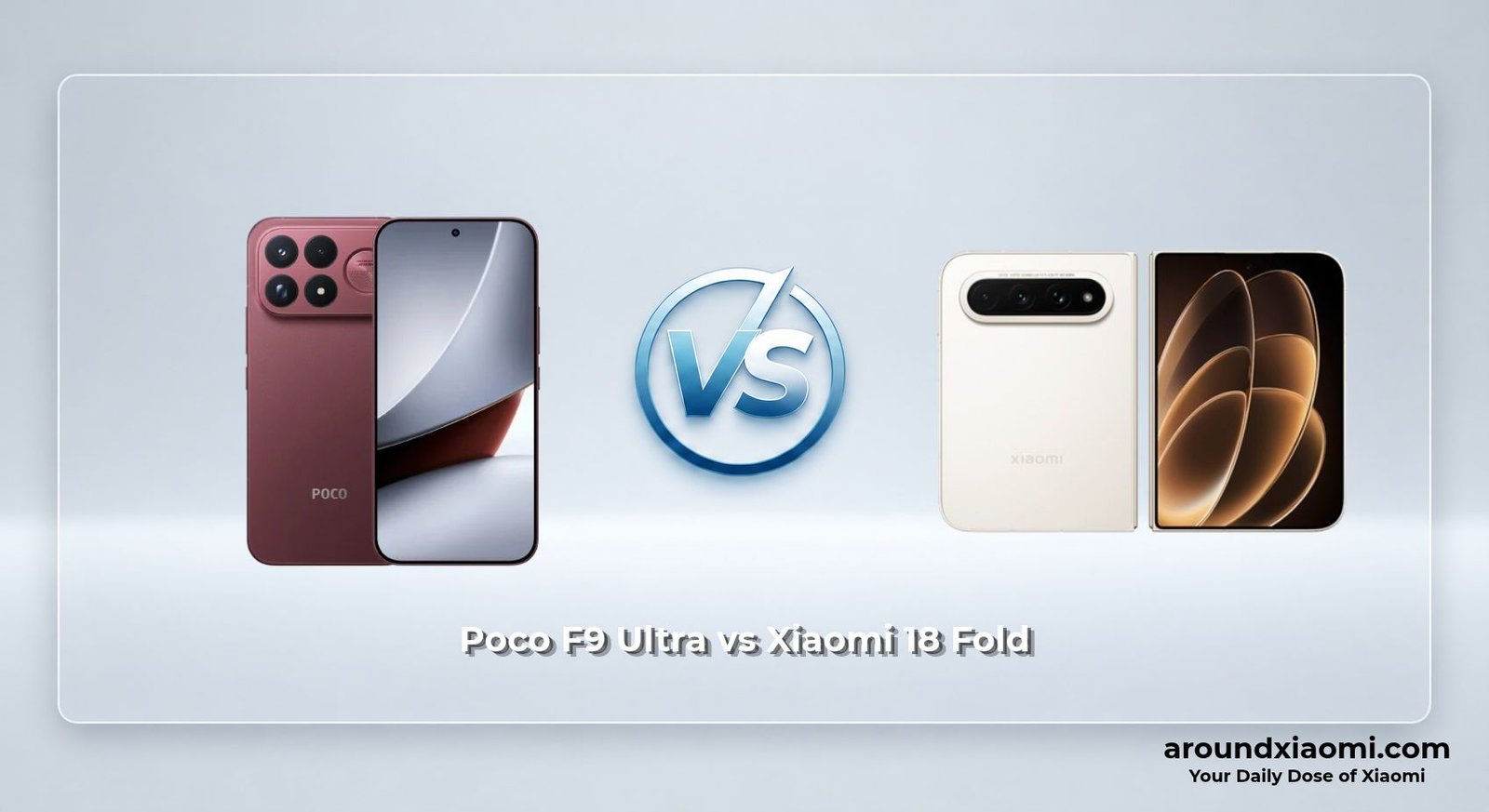
Poco F9 Ultra vs Xiaomi 18 Fold Specs
On paper, the F9 Ultra has a 6.9-inch 185Hz AMOLED screen, a Snapdragon 8 Elite Gen 5, an 8,050mAh battery, 100W wired and 50W wireless charging, and IP68. The cameras are a 200MP main, a 50MP periscope and a 50MP ultrawide. One hands-on report says the battery should last up to two days of light to moderate use. That’s an estimate, not a lab test. The 18 Fold has a 5.38-inch outer screen and a 7.58-inch inner screen, both LTPO OLED at 1–120Hz and up to 4,000 nits. It runs on Xiaomi’s own 3nm XRING O3 chip, with a 6,000mAh battery and 67W wired and 50W wireless charging. Its cameras are a 200MP main, a 50MP ultrawide and a 50MP 3.5x periscope. One reviewer found the crease barely noticeable but the software less polished than Apple’s. Water resistance is murky. One outlet reports IP58/IP59, while Engadget says Xiaomi shared no rating at its hands-on.
Poco F9 Ultra vs Xiaomi 18 Fold Price
The F9 Ultra costs $799 for 12GB/256GB in global markets, €999 in Europe, and RM3,599 in Malaysia. The 18 Fold starts at 10,999 yuan, about $1,640, and it is China-only for now. So the question this page answers is whether a foldable is worth roughly twice the price. For most people outside China, the choice is already made, because only the Poco is something you can actually buy.
Poco’s cheaper option is the F9 Pro, which starts at $699 with a 6,330mAh battery and a slightly weaker chip. Xiaomi hasn’t announced a global foldable, so international buyers have nothing to pair with the Fold. Outside the Xiaomi family, Samsung’s Galaxy Z Fold 8 competes with the Fold and has a smaller 4,800mAh battery. Honor’s Magic V6 is worth a look too. I’d still keep this pairing, because it shows what one company does at two prices and in two shapes.
The Ultra gives you the fastest chip, a 185Hz screen and a Bose-tuned subwoofer for about half the foldable’s price, which suits gaming and video. It’s heavy at 235g, and Poco’s prices have crept up since the F8 generation. The Fold packs a near-A4 inner screen, a 3.5x telephoto and a 6,000mAh battery into 219g, which helps if you read, multitask or edit on the move. You pay for that with a high price, a China-only release, and software reviewers say is still rough.
Pick the Poco F9 Ultra if you want power, battery life and a price you can live with, in a phone sold in many countries. Pick the Xiaomi 18 Fold if screen size and a telephoto camera matter more, and you’re fine with the cost and the limited release.


| |
| Price | $799.00 $1,600.00 |
| Our Rating | |
| Brand | Poco Xiaomi |
| Category | Xiaomi Smart Phones Xiaomi Smart Phones |
Identification
| Phone ID A phone ID typically refers to a unique hardware identifier like an IMEI Number (International Mobile Equipment Identity) that distinguishes your specific physical phone from any other device. | Not found No official model number found |
| Brand / Model A brand model is a strategic framework that defines how a company builds, positions, and manages its identity to connect with customers and guide business decisions. | Poco (Xiaomi sub-brand) / F9 Ultra Xiaomi 18 Fold |
| Variant A variant is something that differs in some way from others of the same kind or from a standard. |
12GB/256GB 16GB/512GB 16GB/1TB 12GB + 256GB 12GB + 512GB 16GB + 512GB (LPDDR5X) 16GB + 1TB (LPDDR6) |
| Release date A release date is the specific day when a product, service, or official piece of information becomes available to the public | September 1, 2026 (global launch) 7 September 2026 (China) |
| Price A price is the amount of money or other compensation that a buyer gives to a seller to acquire a product or service |
$799 / $949 / $1,199 UK £899 base (£709 early bird) Australia AUD $1,499 base Philippines Php55,999 base 12GB + 256GB: ¥10,999 (about $1,640) 12GB + 512GB: ¥11,999 16GB + 512GB: ¥12,999. A Ceramic Special Edition, limited to 1,500 units, is ¥15,999. |
Smartphone Display
| Size Size means how large or small a person, object, or amount is |
6.9 inches
Inner screen - 7.58 in Cover screen - 5.38 in |
| Resolution The measure of sharpness and detail in a digital photo, video, or screen, usually counted in pixels or dots per inch (DPI). | 2,608 x 1,200 pixels (1.5K), about 416 ppi Inner screen - 2364 × 1672; Cover screen - 1712 × 1168 |
| Panel type The panel type of a screen or monitor refers to the specific liquid crystal or diode technology used to display images, which dictates the screen's color accuracy, viewing angles, contrast, and speed. |
AMOLED (Poco HyperRGB), Corning Gorilla Glass 7i
Inner screen - LTPO AMOLED, double-layer UTG, anti-reflective coating Cover screen - LTPO AMOLED, Xiaomi Dragon Crystal Glass 3.0 |
| Refresh rate A refresh rate is the number of times per second a screen updates the image it shows. | Up to 185Hz 1–120Hz adaptive |
| Peak brightness Peak brightness is the highest level of luminance a display screen can achieve for a brief moment in a small area. | 10,000 nits (1% area, HDR) and 4,500 nits (25% area). 2,200 nits HBM, 850 nits typical 4,000 nits |
Smartphone Performance
| Operating system An operating system (OS) is the main system software that manages a computer's physical hardware and provides a base for other programs to run | Xiaomi HyperOS 3 on Android 16 Xiaomi HyperOS 4. Android 17 |
| Chipset A chipset is a group of microchips on a computer's motherboard or electronic device that manages the flow of data between the CPU, memory, storage, and peripheral devices. | Qualcomm Snapdragon 8 Elite Gen 5, plus Poco's VisionBoost D8 chip Xiaomi XRING O3, TSMC 3nm |
| RAM RAM stands for Random Access Memory, which is a device's short-term memory used to temporarily store data that the processor needs right now. | 12GB or 16GB LPDDR5X 12GB or 16GB. LPDDR6 is offered only on the 16GB + 1TB model. |
| Internal storage Internal storage is the built-in, permanent memory inside a device like a smartphone, tablet, or computer used to hold the operating system, apps, and your personal files. | 256GB, 512GB or 1TB UFS 4.1 (no microSD slot) 256GB, 512GB or 1TB, UFS 4.1. No microSD slot. |
| CPU cores A CPU core is an independent processing unit inside a computer's central processing unit (CPU) that reads and executes program instructions. | 8 cores: 2 x 4.36GHz and 6 x 3.53GHz 10 cores: 2× C1-Ultra up to 4.35GHz, 4× C1-Premium up to 3.68GHz, 4× C1-Pro up to 3.15GHz |
| GPU A GPU stands for Graphics Processing Unit, which is a specialized electronic chip designed to rapidly render images, video, and 3D graphics. | Adreno 840 16-core Arm G2-Ultra NX |
Camera
| Main camera A main camera (or primary camera) is the principal, highest-quality imaging lens and sensor system on a device—most commonly located on the rear of a smartphone. |
200MP wide (f/1.7, OIS) 50MP 5x periscope telephoto (f/3.05, OIS) 50MP ultra-wide 200MP, f/1.7, 1/1.56", OIS (Leica optics) 50MP periscope telephoto (f/2.8, 3.5x optical, OIS). 50MP ultrawide (f/2.4). |
| Front camera A front camera is a built-in lens on the same side as a device's screen—such as a smartphone, tablet, or laptop—that points directly at the user. | 32MP 16MP on the cover screen and 16MP on the inner screen |
| Video A video is an electronic recording of moving visual images, usually played with sound on a screen. |
Main: up to 8K at 30fps
rear - 8K at 24fps, 4K at 30/60fps (Dolby Vision), 1080p at 30/60/120/960fps, gyro-EIS and OIS front - 1080p at 30/60fps |
Smartphone Battery & Charging
| Battery Capacity Battery capacity is the total amount of electrical energy a battery can store and deliver, functioning much like the size of a fuel tank. | 8,050mAh silicon-carbon 6,000mAh silicon-carbon |
| Wired charging Wired charging means using a physical cable to connect a device directly to a power source to transfer electricity into its battery. | 100W (27W reverse) 67W (PD 3.0, 50W PPS) |
| Wireless Charging Wireless charging is a cable-free method that powers electronic devices by transferring energy through electromagnetic fields instead of a physical plug. |
Smartphone Connectivity
| 5G support 5G support means a device or network can connect to the fifth-generation cellular mobile network, delivering much faster download speeds and lower response times than older 4e and 4G LTE systems. | |
| SIM type A SIM (Subscriber Identity Module) type or size refers to the physical dimensions or digital architecture of the smart chip that connects your phone to a mobile network. | Nano-SIM and eSIM (dual SIM) Dual nano-SIM |
| Wi-Fi version A Wi-Fi version is a specific generation or technical standard of wireless networking technology that determines your device's speed, range, and connection quality. | Wi-Fi 7 (802.11 a/b/g/n/ac/ax/be) Wi-Fi 7 (backward compatible), Wi-Fi Direct |
| Bluetooth version A Bluetooth version is the specific update level of the wireless rules that a device uses to connect and share data | 6.0 6.0 (A2DP, LE, LHDC 5) |
| NFC NFC stands for Near Field Communication, a short-range wireless technology that lets two electronic devices exchange data when they are placed a few centimeters apart. | |
| USB USB stands for Universal Serial Bus, a global standard connection for passing data, power, and video signals between computers and electronic devices. | USB-C 3.2 Gen 1, with video output to external displays USB 3.2 Type-C |
Build & Design
| Weight Weight is the downward force that gravity exerts on an object. | 235g 219g |
| Dimensions A dimension is a measurement in a specific direction (such as length, width, or height) or a distinct aspect, feature, or scope of a situation. | 163.49 x 77.94 x 8.74mm Folded: 117.8 × 83.6 × 10.68mm. Unfolded: 117.8 × 163.8 × 5.02mm. |
| Water resistance rating A water resistance rating measures how much static water pressure a device or material can withstand before leaking or failing | IP68, up to 1.5m for 30 minutes IP58/IP59 |
| Dust rating A dust rating is the first number in an Ingress Protection (IP) code that shows how well a device keeps out solid objects and dust. | IP68 IP58/IP59 |
| Materials A material is a physical substance or matter used to make objects, build structures, or create products | Glass-fiber back, metal frame, Gorilla Glass 7i front Aluminium frame (7000-series), glass back, Xiaomi Dragon Crystal Glass 3.0 on the cover, ultra-thin glass on the inner screen, three-link hinge |
| Available colors different color choices that are ready for you to buy or pick for a product. | Black, Dark Cherry Black, Warm Gold/White, Nishino Red, plus the Ceramic Special Edition. |
Extras
| Biometrics Biometrics refer to the measurement and statistical analysis of unique physical and behavioral human characteristics used for identification and verification. | In-display ultrasonic fingerprint sensor Side-mounted fingerprint sensor built into the power button. |
| Audio Audio means sound, or the recording, transmission, and reproduction of sound within the range of human hearing. | Bose-tuned 2.1 system: two 1115D stereo speakers and a 1620 subwoofer. No 3.5mm jack. Stereo speakers with Dolby Atmos |


|
New Arrivals



Popular Posts